"It is connected to Shanggu in the east, reaches Bingheng in the south, borders the Yellow River in the west, and controls the desert in the north. It occupies a strategic location on the border and is a true bulwark of the capital."
Gu Zuyu, a geographer from the late Ming and early Qing dynasties, made this assessment of Datong, Shanxi (then known as Datong Town).
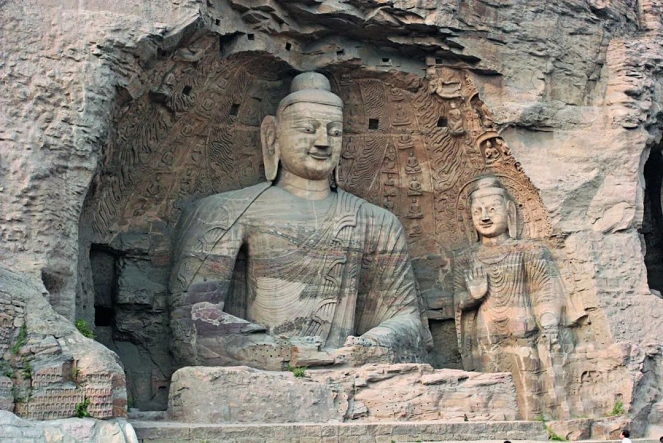
▲The open-air Buddha statue in Cave 20 of Yungang Grottoes in Datong.
Shanxi, a land of mountains and rivers, is one of the important birthplaces of the Chinese nation and Chinese civilization, and is known as "the heart of five thousand years of civilization." In northern Shanxi, the Great Wall and the Hu Huanyong Line, important landmarks of Chinese historical geography, roughly traverse the Sanggan River Basin, where Datong is located, in east-west and north-south directions, respectively. As the core area of the agro-pastoral transition zone in northern my country, this region has historically been a stage for the great collision and integration of the Central Plains agricultural civilization and the northern nomadic civilization. War and peace alternated here and there; during times of conflict, it served as the front line for the Central Plains dynasties and surrounding regimes; while in longer periods of peace, it was a vital passage and hub for the exchange of goods and cultural traditions between the north and south. Therefore, besides the wilderness along the Great Wall and the Hu Huanyong Line, numerous towns benefited from the interaction, exchange, and integration of various ethnic groups, and Datong is one of them.
According to research, "Datong" gradually evolved from "Pingcheng." Roughly speaking, it has been called "Pingcheng" for over 1500 years, and "Datong" for 978 years. With a global vision, the name "Datong" embodies humanity's primal desire to bid farewell to conflict, transform swords into plowshares, and embrace peace. It symbolizes the universal aspiration of all peoples for a harmonious and beautiful Datong.
A world of great harmony and coexistence. "Datong" (Great Harmony)—what an auspicious and beautiful name! But what profound historical meaning lies behind the name "Datong"? What lessons can we learn from Datong's past and present? To explore these questions, our reporter recently interviewed Ren Yong, Chairman of the Datong Writers Association in Shanxi Province.
Reporter: Over the years, you must have touched and experienced the Yungang Grottoes countless times. So, what are the Yungang Grottoes like in your eyes?
Ren Yong: The Yungang Grottoes are an invaluable historical and cultural heritage left to posterity by the Northern Wei minority regime. They represent a milestone in the integration of Eastern and Western cultures, minority cultures and Central Plains cultures, and Buddhist art and stone carving art. Therefore, from ancient times to the present, all dynasties have held the Yungang Grottoes and the Northern Wei Dynasty in high regard.

▲Partial view of the murals at Yungang Grottoes in Datong.
The Yungang Grottoes are undoubtedly a treasure trove of world-class sculptural art. More than 1,500 years ago, top artists and sculptors from the Northern Liang region (present-day Wuwei area of Gansu) and other places jointly created this masterpiece that blends Central Plains, Western Regions, and Eastern and Western artistic styles. This demonstrates that the Hexi Corridor was not only the first passage for Buddhism to enter China, but also the first passage for Western art to enter China.
The Yungang Grottoes are an irreplaceable physical symbol of Datong's status as an ancient capital of China and a powerful testament to its grandeur. In Datong, the Yungang Grottoes undoubtedly bear witness to the real existence of Pingcheng, the capital of the Northern Wei Dynasty, a metropolis with a population of 1.5 million, a rare sight in the world.
The Yungang Grottoes also serve as a living catalogue of many outstanding traditional Chinese cultural projects in the fields of academic research and inheritance and protection. For example, the music cave within is enough to keep experts and scholars focused for decades, or even devoting their entire lives to its study and analysis. One can imagine how magnificent it would be if, based on this cave, a musical and dance drama integrating various styles from the Central Plains, nomadic, and Western Regions—"Northern Wei Court Music and Dance"—were created.

▲Music Cave of Yungang Grottoes, Datong.
Furthermore, in the history of the spread and development of Buddhism in my country, the Yungang Grottoes are a symbol of the great development of Buddhism after its entry into China, especially the exchange, mutual learning, and harmonious coexistence among various religions. At that time, Emperor Wencheng Tuoba Jun, the decisive ruler, invited the eminent Buddhist monk Tan Yao to serve as the chief designer and art director. Tan Yao, along with the Buddhist masters Fa Guo and Shi Xian of the Northern Wei Dynasty, all came from the Northern Liang. It was the promotion and development of Buddhism in the Northern Liang that paved the way for the later widespread spread of Buddhism in the Central Plains.
Reporter: The name Datong is particularly meaningful. Where does it come from?
Ren Yong: The term "Great Harmony" has been discussed by many ancient Chinese thinkers. Zhuangzi said, "In discussing the physical body, one should conform to the Great Harmony; in the Great Harmony, there is no self." This means that all things in heaven and earth, including humankind, should be integrated with each other. More than 2,400 years ago, Confucius interpreted "Great Harmony" in the "Book of Rites: The Great Learning" as the world belonging to all.
The Great Harmony of today was not originally called Great Harmony.
Datong has a recorded history spanning over 3,000 years. During the Warring States period, Datong was under the jurisdiction of the Zhao state, which had Yunzhong Commandery, Dai Commandery, and Yanmen Commandery established in its northern, northeastern, western, and southern parts. Later names related to "Dai," such as the State of Dai and the King of Dai, are largely associated with this "Dai Commandery." During the Qin, Han, Three Kingdoms, and Jin dynasties, Datong was consistently at the forefront of exchanges between the Central Plains and the north, as evidenced by the Great Wall at Datong. When the Northern Wei dynasty established its capital in Datong, Emperor Daowu naturally retained the name of his grandfather's former State of Dai before later changing it to "Wei."
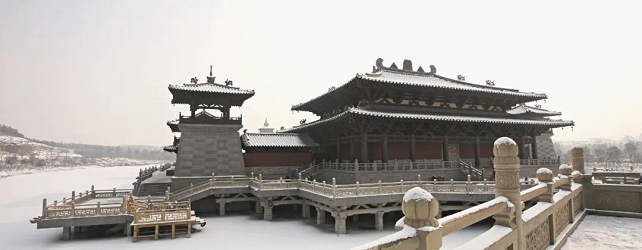
▲The ancient city of Datong in the snow.
The Northern Wei dynasty's decision to establish its capital at Pingcheng, located beneath the Great Wall, was a choice made by Emperor Tuoba Gui after careful consideration of the pros and cons. Pingcheng's location largely mirrors that of the present-day ancient city of Datong, but its area was two to three times larger, with vast territories extending north and east. The Imperial River flowed gently from northwest to southeast through Pingcheng, merging with the Sanggan River within present-day Yunzhou District, before flowing northwards.
When discussing Datong's past glory, it's generally described in eight words: capital of three dynasties, important town of two dynasties. Besides being the capital of the Northern Wei Dynasty, Datong also served as a secondary capital for the Liao and Jin dynasties. The Liao Dynasty was established by the Khitan people, and the Jin Dynasty by the Jurchen people; both, like the Tuoba Xianbei, belonged to northern nomadic groups. The title of "important town of two dynasties" refers to the fact that during the Ming and Qing dynasties, Datong remained a crucial gateway between the Central Plains and the northern grasslands and deserts, holding the "key to the north."
In the thirteenth year of the Chongxi reign of the Liao Dynasty ( 1044 ), Yunzhou Prefecture was elevated to Datong Prefecture, becoming a secondary capital of the Liao Dynasty. Previously, Datong's names such as "Dai," "Ping," and "Yun" also conveyed auspicious meanings of fairness, freedom, peace, and generational inheritance. However, it wasn't until Emperor Xingzong of Liao that the profoundly meaningful name "Datong" was adopted. Perhaps influenced by the concept of "Datong," during the Liao and Jin periods, although the Liao Dynasty confronted both the Northern and Southern Song Dynasties, it generally maintained a balance of power for over 300 years. From then on, this peaceful and blessed city continued to use the name Datong.
Reporter: In the formation and development of the pluralistic yet unified pattern of the Chinese nation, the adoption of nomadic dress and cavalry archery, and the reforms of Emperor Xiaowen of the Northern Wei Dynasty, greatly promoted exchanges and integration among various ethnic groups, which were of great significance. What is the connection between these two events and the concept of Great Harmony (Datong)?
Ren Yong: These two grand dramas of ethnic integration were largely staged within the Datong region.
Let's first talk about King Wuling of Zhao's adoption of nomadic dress and cavalry tactics during the Warring States period. In essence, it was the Han Chinese of the Central Plains learning from the nomadic peoples, mainly including changes in clothing and military affairs.
At that time, the State of Zhao was building the Great Wall at the foot of Yinshan Mountain, intending to forge Datong into a strong defensive barrier. During the Warring States period, Zhao faced threats not only from the other six states but also from the surrounding Zhongshan State and nomadic tribes such as the Linhu and Loufan. King Wuling of Zhao was the first leader of an agricultural people to learn from nomadic peoples. During his campaigns against the Hu people, he realized that the long robes and wide sleeves of the Zhao people were extremely inconvenient for marching, fighting, and farming, far less convenient than the short, narrow-sleeved clothes and leather boots of the Hu people. He declared that Zhao should adopt the Hu clothing system, and all soldiers must learn to ride horses and shoot arrows. Thus, from clothing to chariots, from military affairs to civilian life, adopting Hu clothing and riding archery eventually became a conscious action for all the people of Zhao. King Wuling also boldly employed Hu people and heavily relied on talents from minority groups such as the Loufan and Xiongnu. Later, the Hu people, defeated by Zhao, began to admire the people of the Central Plains and began wearing long robes and wide sleeves. The adoption of nomadic dress and archery by the Zhao state was quickly imitated by the other six states, and it became fashionable for people in the Central Plains to learn from the nomadic people.

▲A glimpse of Datong Ancient City.
As for the Sinicization reforms led by Emperor Xiaowen of the Northern Wei Dynasty, including the relocation of the capital from Pingcheng to Luoyang, its essence was the nomadic people embracing Central Plains culture, mainly including the Taihe Reforms and the subsequent thorough Sinicization. I believe the Tuoba Xianbei did this primarily because of their admiration and yearning for Central Plains culture. The history of the Northern Wei Dynasty proves that only through interaction, exchange, and integration among various ethnic groups can such remarkable achievements as the Taihe Reforms be born. Achieving this was extremely rare at the time. As the last of the "Five Barbarian Tribes" to enter the Central Plains, the Tuoba Xianbei embraced diverse influences and humbly accepted the advanced civilization of the Han people. From hunting to nomadism, from nomadism to agriculture, and then to establishing their capital at Pingcheng, they were no longer the Tuoba clan that once lived in the Gaxian Cave. Just like the story that their founding emperor, Emperor Daowu Tuoba Gui, always told, he said: "Although we once lived on the grasslands and in the forests, we are descendants of the Yellow Emperor. One day we will return to the banks of the Yellow River, to the birthplace of Chinese civilization, where our roots lie." Perhaps this is just a story, but the Tuoba Xianbei's long-standing admiration and yearning for Central Plains culture is undeniable. This may well be the driving force behind Emperor Xiaowen's ultimate decision to move the capital to Luoyang and completely Sinicize the region.
It was against the backdrop of the Sinicization reforms of the Tuoba Xianbei that Sima Jinlong, a descendant of Sima Yi during the Three Kingdoms period, voluntarily came from the Eastern Jin Dynasty to the Northern Wei Dynasty and was enfeoffed as the Prince of Langya. In the mid- 1960s , artifacts such as the painted lacquer screen unearthed from the Sima Jinlong tomb in Datong became a microcosm of ethnic integration and cultural exchange during the Northern and Southern Dynasties. It is worth pondering that the Xianbei people inherited the genes of their ancestors; from Yang Jian and Yang Guang to Li Yuan, all had intricate connections with the Northern Wei Dynasty. No wonder a contemporary cultural figure once remarked before the Yungang Grottoes: "From here, China marched towards the Tang Dynasty."
Reporter: It seems that Datong is indeed a land with a long history and profound cultural heritage. I've heard that some early human civilization sites have been unearthed in Datong, and in recent years there have been significant discoveries regarding late Neolithic human civilization. Could you please talk about this?
Ren Yong: Millions of years ago, Datong was a vast lake, which the academic community named Datong Lake. Around 30,000 years ago, the lake disappeared, leaving behind a legacy on the Loess Plateau. The Sanggan River, receiving numerous streams of varying sizes originating from the Guancen Mountains, Duandian Mountains, Xiaoquan Mountains, and Matou Mountains, as well as tributaries such as the Yuhe River, flows towards Hebei and Beijing, eventually emptying into the Bohai Sea. The Sanggan River culture, embodying the indomitable and resilient spirit of the Chinese nation, was born from this.

▲The ruins of the Great Wall in Datong at sunset.
Decades ago, dozens of early human sites dating back over a million years were unearthed in the Sanggan River basin. For example, the internationally renowned Nihewan site complex includes the Xujiayao Middle Paleolithic site in Yanggao County, Datong. In recent years, Late Neolithic human civilization sites have been discovered at the foot of Matoushan and Dianshan mountains. Excavation and research indicate that approximately 4,500 to 5,000 years ago, the ancient humans living and thriving here had already mastered stone tool technology and were highly skilled in agriculture and pottery making. Archaeologists have also engaged in heated discussions surrounding a newly unearthed skull, with some believing it to be the "representative" of the first generation of beautiful women in Datong, and dubbing it "Little Aunt." Such archaeological excavations and research are still ongoing, and the history of human civilization in the Sanggan River basin may even be rewritten here.
Reporter: We know you once wrote a song called "Datong Blue," which includes the lyrics "Datong Blue, beyond Yanmen Pass, south of the grasslands," describing Datong's natural geography. Datong is located beneath the Great Wall; looking north from the Great Wall, one sees grasslands and deserts, nomadic lands; looking south, one sees the famous Yanmen Pass, beyond which lies the Central Plains, an agricultural region. This unique geographical location has given Datong an important place in the process of ethnic integration. What are your thoughts on this?
Ren Yong: Datong has been an important area for ethnic integration since ancient times, which is closely related to its geographical location. Historically, Datong has been known as the "Key to the North," a vivid and apt description highlighting its strategic importance. Whoever held the key and the lock held the potential to dominate the region. For this reason, Datong is also known as the "Hometown of the Great Wall," a natural museum of the Great Wall. The Great Wall within its borders stretches 493 kilometers, with numerous beacon towers, watchtowers, passes, cities, forts, garrisons, strongholds, stockades, platforms, and watchtowers scattered throughout, all relatively well-preserved to this day. To defend the Datong and Xinding basins and thus protect the capital, the Ming Dynasty constructed multiple border walls and numerous passes and military forts of varying levels. In the Ming Dynasty's Nine Garrisons system, Datong Garrison defended the northern outer Great Wall, known as the "First Garrison," highlighting its crucial position.
Both inside and outside the Great Wall, we are all home. Due to its unique geographical location, history has seemingly bestowed upon Datong a greater responsibility and mission in terms of ethnic integration.

▲The ancient city of Datong at sunrise.
From the Siege of Baideng faced by Emperor Gaozu of Han to Emperor Daowu of Northern Wei establishing his capital at Pingcheng, from the legendary Yang family generals who dominated Yanmen Pass to the "tribute and trade" system during the Longqing era of the Ming Dynasty... a series of vivid dramas unfolded here, depicting the interactions, exchanges, and integration between agricultural and nomadic peoples, leaving behind numerous cultural imprints. It can truly be said that they are intertwined, with mutual dependence and support becoming the norm in the lives of the local people.
Do you know "Haihaiqiang" Shuahair? It's a local opera genre in Datong, with a very unique singing style and rhythm. Legend has it that Shuahair's origin is closely related to Wang Zhaojun's journey to the border. When the procession to marry the Han princess rested in Pingcheng, Wang Zhaojun, longing for home, sat in an inn, playing her pipa and weeping to express her endless longing. Later, this kind of tune, which is both crying and shouting, singing and speaking, expressing deep longing and a sense of yearning, with its ruggedness of the grasslands and tenderness of the Central Plains, became a very popular local opera tune and was included in the Twelve Palace Tunes of Yuan Dynasty opera. It is still widely circulated among the people today.

▲Datong folk Yangko dance.
When the documentary crew of "A Bite of China" was filming in Datong, the director asked me what the biggest characteristic of Datong's cuisine was. I replied, "The biggest characteristic of Datong's cuisine is that it doesn't strive for its own unique style. As long as the food is delicious, it will be welcomed in Datong, regardless of where it's from or even overseas." This answer delighted them. Indeed, Sichuan, Hunan, Cantonese, Shanghai, and Shandong cuisines, as well as grassland barbecue, Northeastern cuisine, and Xinjiang cuisine, can all be found in Datong, and they attract a large number of diners. This spirit of integration allows Datong to continue its vibrant tradition of "cuisine from all over the world."

▲Daily life in the ancient city of Datong.
Datong's local cuisine is quite interesting. Among the four traditional cooking techniques of frying, stir-frying, braising, and deep-frying, it leans towards braising, which is called "stew" in the local dialect. With the gradual integration of various ethnic lifestyles, Datong's cuisine has become a comprehensive system encompassing frying, stir-frying, braising, deep-frying, and roasting, with stews becoming an
integral part of daily life. It's easy to imagine that during the Northern Wei Dynasty, Pingcheng, this vast international metropolis, was a place where palaces, military camps, and residential neighborhoods coexisted. People from the Central Plains, the North, and the Western Regions lived together in one city, enjoying the warm sunshine and the lively atmosphere – a scene worthy of the saying, "Let's cook beef and slaughter sheep for pleasure, and drink three hundred cups of wine in one go!"
Reporter: Datong has a lot to offer in carrying forward China's excellent traditional culture and allowing this historical and cultural city to shine with new brilliance in the new era. What are your thoughts on this?
Ren Yong: Let's start with a smaller point! The Datong Writers Association is advocating for the development of a cultural tourism project: "Half-Month Datong." This means that visitors from other places won't be able to fully experience Datong in less than half a month. At the same time, we plan to use travelogues to document all the beautiful, fun, worthwhile experiences, and insightful things Datong has to offer, creating several classic tourist routes, such as ethnic integration routes, religious culture routes, geological landscape routes, and red tourism routes. This will allow tourists to easily refer to these travelogues and plan their trip through Datong. For example, the religious culture route could connect the Yungang Grottoes, Huayan Temple, Shanhua Temple, and Mount Heng (Northern Peak), the Hanging Temple, and Thousand Buddha Ridge, leading tourists to explore the mysteries of cultural exchange and mutual learning, experiencing the magnificent grotto culture before embarking on the wondrous journey of "Mount Heng as if walking through it"...

▲Hanging Temple of Mount Heng (Northern Peak).
Currently, 38 ethnic groups live in Datong , with approximately 16,000 ethnic minorities residing there in peace and contentment. In my view, the people of Datong have long had the blood of ethnic integration flowing in their veins. It's the same principle as the Tuoba Xianbei people who came to Pingcheng; they were no longer entirely the Tuoba clan that originated from Gaxian Cave.

▲Datong Ancient City.
Over the years, Datong's development has been remarkable and exhilarating. Examples include the construction of the ancient city and the government's strong promotion of cultural and tourism development. Particularly noteworthy is the burgeoning popularity of literature and art with historical and regional characteristics, with unprecedented interest and passion for Datong's history and culture among professionals and citizens. In recent years, I myself have given dozens of lectures on history, literature, and especially Northern Wei culture in libraries, schools, businesses, and government offices. The Datong Writers Association, in collaboration with the Pingcheng District Government, launched the "Northern Wei Historical and Cultural Figures Biographical Literature Series," written by local authors, which has received attention and praise from the national literary community and readers.
Beauty shared by all, a world of great harmony. In short, I have always loved and looked forward to Datong, a place with a long history, splendid culture, and magnificent nature!
(The author, Ren Yong, is the chairman of the Datong Writers Association in Shanxi Province. This article was published in the November 2022 issue of the magazine *Chinese Nationalities* . All images in this article were provided by the author.)